How is the software provided?
The software is made available via the internet as a cloud solution; alternatively, an on-premise installation can also be implemented on request. However, this does not require any personal data to be transferred to the cloud. We have developed a special pseudonymization procedure for this purpose, which is explained later in this document.
What data is needed?
The data to be used always depends on the business case and should follow the principle of “data minimization”. As a rule, general characteristics of the customer, such as customer status, age or gender, as well as information on their products and, if applicable, transactions are used. If available, further data, such as contact history, can be integrated. The data required for the business case to be implemented depends on availability and is determined together with the Adtelligence customer.
How does the data get into the software?
The most common way is a CSV data export from the BI system, the CRM or e.g. from the credit card processor. A daily extract with the necessary data should be exported fully automatically; alternatively, manual data extracts can also be defined and provided. If your system does not have a corresponding built-in export function, we will be happy to support you with automation. However, we can of course also integrate other interfaces. The transfer to the Adtelligence platform is encrypted via SFTP (Secure File Transfer Protocol). Alternatively, other interfaces (e.g. cloud shares) can also be used for integration.
How does the pseudonymization of data work?
The Adtelligence software can work with an anonymous identifier and does not require any personal data or customer, credit card or account numbers. The data can be masked in advance on the customer side before data is transferred to Adtelligence.
If the customer is unable to provide pseudonymization, the data splitter developed by Adtelligence can be used:
A data splitter is interposed in the export for this purpose, which pseudonymizes and filters the data. The data flow is illustrated in the following graphic. Adtelligence never has access to the personal data, but can still trigger the appropriate action, e.g. an email from an external connected email system. The data splitter separates the personal and contact information relevant to the playout channels from the rest of the data record. From the remaining data, the fields that are required for a suitable customer group selection are selected and transferred to Adtelligence. Data fields that are neither relevant for communication channels nor for decision-making, such as customer, credit card or account numbers, are discarded by the data splitter if they exist. For subsequent assignment in the playout, an identifier is attached to each of the two data records, which cannot be traced back to a person without the data of the communication channel.
Example of the pseudonymization process – email communication channel
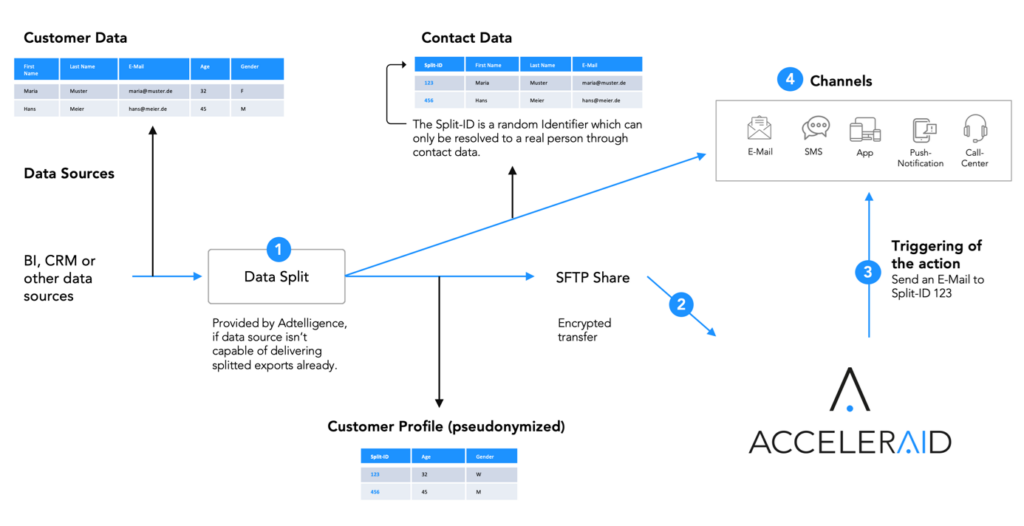
- Separation of the customer profile from personal data
- Transfer of customer data without personal identification to Adtelligence
- Adtelligence delivers action & recipient (e-mail campaign and customer ID) to e-mail system
- Email system reconnects ID to name and email address etc. to send personalized campaigns
What are the steps involved in technical integration?
Throughout the integration process, Adtelligence’s team of experts will support you to make the integration as simple and smooth as possible. The technical integration takes place in the following steps:
- You check in which systems you have the required data and provide a sample data record, preferably with a field description. The data format is not fixed and can be determined by you.
- Adtelligence checks the data set and defines the integration architecture together with you:
- Data sources involved (which systems supply data).
- Type of data transfer and formats (SFTP and CSV, or others).
- Data splitter – possibly this function can be fulfilled directly by the data source. If not, Adtelligence will supply a component adapted to your environment.
- Communication channels involved – existing systems (e.g. email providers) can be connected, or Adtelligence can supply these with partners.
- If desired, data flows back into your systems.
3. Technical implementation phase
- Adtelligence provides the system and the SFTP share.
- You set up the data exports (automated & daily at best).
- Adtelligence configures the system, integrates your data and connects the communication channels.
This completes the technical integration and you can start with the first business cases.
What do I need to provide?
- Regular (at best automated, daily) export of the data with field description (data dictionary). Depending on the business case, this includes
a. Customer data (e.g. age, gender, customer since…)
b. Product data (which (card) products the customer has)
c. Transactions (terminal name, time stamp, amount)
d. Additional data fields if necessary (depending on the business case)
2. Overview of the connected systems (data sources and communication channels)
3. Interface information/technical documentation on the communication channels. For example, the API documentation of the email provider that is to be used.
Example: Email communication channel: What is the process?
1. Texts and images (email variants) are still created in the email tool
2. Email variants are automatically synchronized with the Adtelligence platform
3. Campaign is created in the Adtelligence system and at least one email variant is selected from the email tool
4. Adtelligence sends daily information to the e-mail tool (user ID and e-mail variant) about which e-mail is to be sent to which customer.
5. Email tool then reconnects the user ID to the actual name and finally sends the e-mail campaigns
Return e-mail dispatch and opening confirmation
The report on which emails were successfully sent and opened by the recipient should flow back to Adtelligence from the email provider. As with sending, you have the option of transmitting this report directly – but it may then only contain the pseudonymized IDs – or you can interpose a pseudonymization of the report on your side.